

If you paid attention to the noise this year, you’d think all the money flowed into AI, climate tech, and whatever the latest “industry-defining” trend was supposed to be. But you know how this works. The loudest rooms rarely hold the best deals. The smartest checks in 2025 weren’t chasing buzzwords; they were backing businesses solving boring but essential problems, building infrastructure quietly, and capturing real revenue while everyone else argued over valuations on social media.
This was the year you won by taking the road less traveled. Because while the hype cycles spun out of control, a handful of sectors quietly became the dark horses of the investment landscape: steady, gritty, and delivering returns without ever being called “the next big thing.”
So, if you’re thinking about where the real opportunities were hiding in plain sight, let’s break down the industries that actually outperformed in 2025.
Industrial Automation for SMBs: The Efficiency Revolution
Automation has been dominating enterprise operations for years, but in 2025, the real breakout came from a different corner. Small and mid-sized manufacturers are finally adopting automation on a massive scale.
What made this sector so compelling wasn’t fancy robotics or futuristic tech. It was simple math. Labor shortages, rising wages, and supply chain pressure pushed SMBs to seek affordable, modular automation tools. Companies offering plug-and-play robotics, AI-assisted quality checks, and workflow optimization became irresistible.
The investors were betting on operational necessity, and necessity always pays. These businesses reported strong ARR, short sales cycles, and surprisingly sticky customers, giving angels a clear path to exits through acquisitions by larger industrial players.
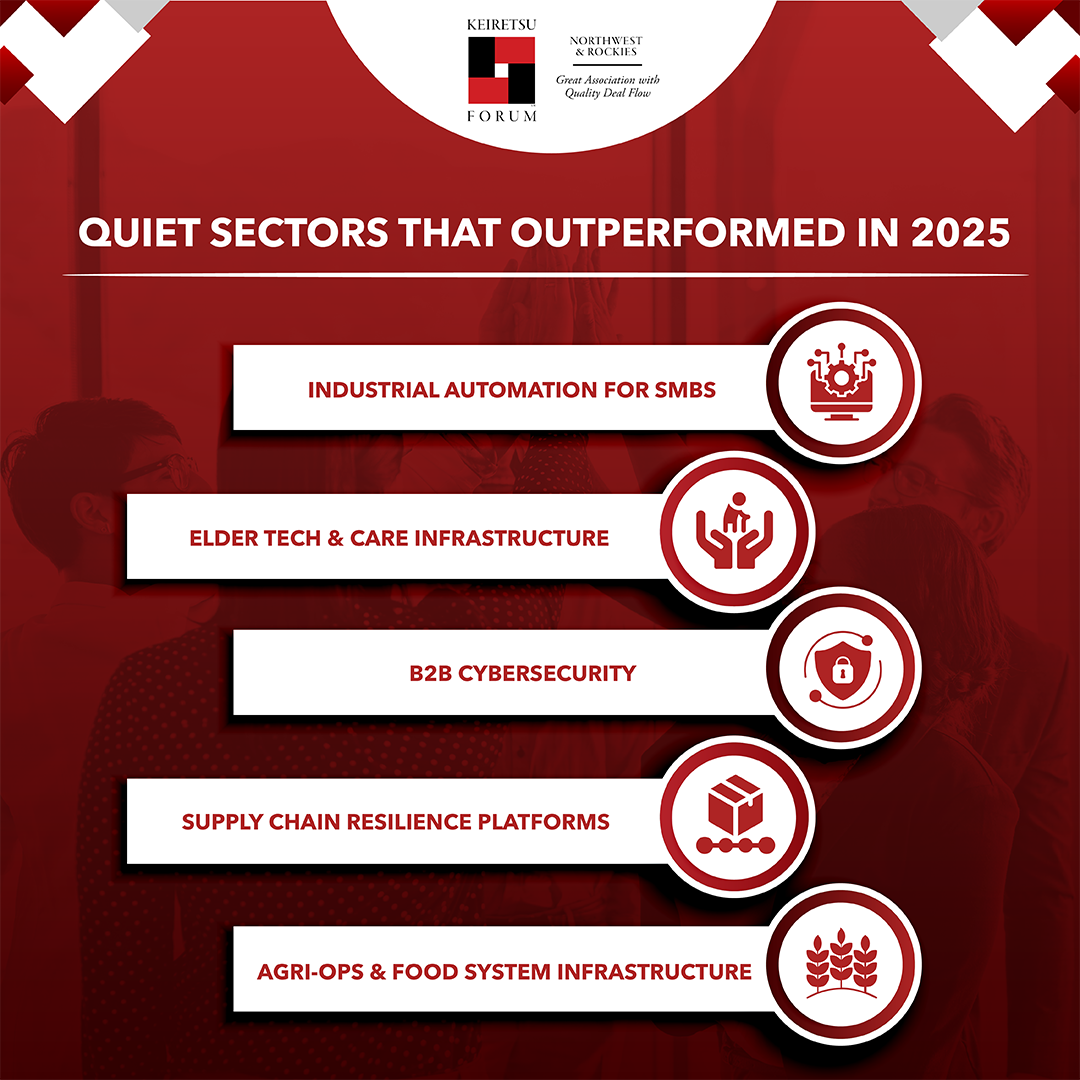
Elder Tech & Care Infrastructure: The Silent Demand Surge
While the world obsessed over AI copilots, companies focused on elder care infrastructure quietly became profit machines. Trends will come and go, but people get older every year, and that opens up wellness opportunities.
Businesses are now offering value through remote monitoring tools, in-home safety tech, caregiver management platforms, and aging-in-place services. Unlike consumer wellness apps, these solutions plugged into real pain points, such as overloaded care facilities, exhausted families, and an under-resourced system.
Most of these companies were building evidence-backed, regulated-ready systems that earned reimbursement pathways and built partnerships with health networks. For angels, that meant early revenue, predictable adoption curves, and strong acquisition interest from insurers and large healthcare operators.
B2B Cybersecurity For The “Forgotten Middle”
Cybersecurity? Not new. But the winners in 2025 were the companies serving the “middle layer” of the economy: businesses too big to ignore security, too small to hire in-house experts.
In the last few years, SMB cyberattacks have spiked, insurance premiums have skyrocketed, and compliance requirements have tightened. Suddenly, mid-market businesses were willing to pay for turnkey security solutions - continuous monitoring, breach simulation, automated compliance, and response-ready playbooks.
This category gave you low churn, expansion revenue, and predictable ARR. Better still, many of these solutions layered AI on top of existing protocols, giving angels exposure to the AI tailwind without funding companies that shouted “AI” 20 times in their slide decks.
Supply Chain Resilience Platforms: The “Next Normal” Advantage
2025 was the year supply chain uncertainty went from a pandemic hangover to a permanent state. Instead of “fixing” the system, you saw companies helping businesses adapt to volatility.
Investors leaned toward solutions offering:
- Real-time supplier visibility
- Predictive inventory tools
- Risk scoring for vendors
- Alternative sourcing automation
These weren’t flashy products, but they were lifesavers in categories like electronics, food processing, defense, and medical equipment. And unlike most early-stage companies, many supply chain platforms earned revenue from day one because customers already felt the pain.
Agri-Ops & Food System Infrastructure
Investor support for agri-ops, in a sense, supported the country's operational backbone. In 2025, businesses offering logistics optimization for food distributors, spoilage-reduction tools, cold-chain analytics, and farmer-to-retailer workflow systems quietly became some of the most capital-efficient success stories.
The secret to their success is that they shifted their focus to real-world constraints: labor shortage, wastage, compliance, and unpredictable demand cycles. As a result, margins were better than expected, and many of these companies scaled through partnerships with co-ops and regional suppliers, a strong sign of future consolidation and exits.
2025 Was A Year of Quiet Markets, Loud Returns
If 2024 taught you to chase the wave, 2025 reminded you why smart money rarely surfs. It swims deeper.
The winners this year were the entrepreneurs and companies solving invisible problems, the sectors reshaping boring but essential parts of the economy, and the investors (like you) who had the patience to look past the trending hashtags. And if 2025 is any indicator, that’s exactly where your next outsized return is waiting for you.
