

You can usually pinpoint the exact moment things started to go wrong, but only in hindsight.
It’s the board meeting that felt heavier than usual. The entrepreneur who stopped asking questions. The email was technically polite but unmistakably defensive. Nothing “bad” happened, yet something shifted.
In venture-backed companies, value rarely erodes overnight. It leaks out through unresolved tension, rushed reactions, and conversations that never quite land the way they should. When pressure rises, the difference between a productive correction and a costly escalation comes down to one skill: your ability to create space between stimulus and response.
This concept was introduced by Amy L Brodsky, CEO at Sky Partners, in her keynote ‘The Habit High Performers Master: Embracing Difficult Conversations’ at the Investor Capital Expo in August 2025.
Difficult Conversations Are a Governance Issue
In VC-backed companies, speed is celebrated, and decisiveness is rewarded. But those same traits become liabilities when conversations turn emotional.
When you react too quickly:
- Entrepreneurs feel attacked rather than supported
- Boards escalate instead of de-risking
- Misalignment becomes personal
- Documentation replaces dialogue
From an investor’s perspective, this is where exposure begins. What starts as a disagreement about strategy can quickly turn into:
- Talent attrition at the executive level
- Breakdown of trust between board and management
- Regulatory or fiduciary missteps
- Litigation that could have been avoided
At this moment, creating space between stimulus and response is about ensuring the decisions you make under pressure still serve enterprise value.
The Core Principle: Separate Emotion From Information
Every difficult conversation contains two layers: The emotional reaction (fear, frustration, ego, urgency) and the underlying information (facts, performance, risk, incentives). Your job is to prevent the first from distorting the second.
When an entrepreneur misses a forecast, resists board guidance, or pushes back aggressively, your instinct may be to correct, assert authority, or escalate. But when you respond emotionally, you validate their defensiveness and narrow the room for resolution.
Instead, your objective is to slow the interaction without losing momentum. That space, sometimes just minutes, sometimes days, is where clarity returns.
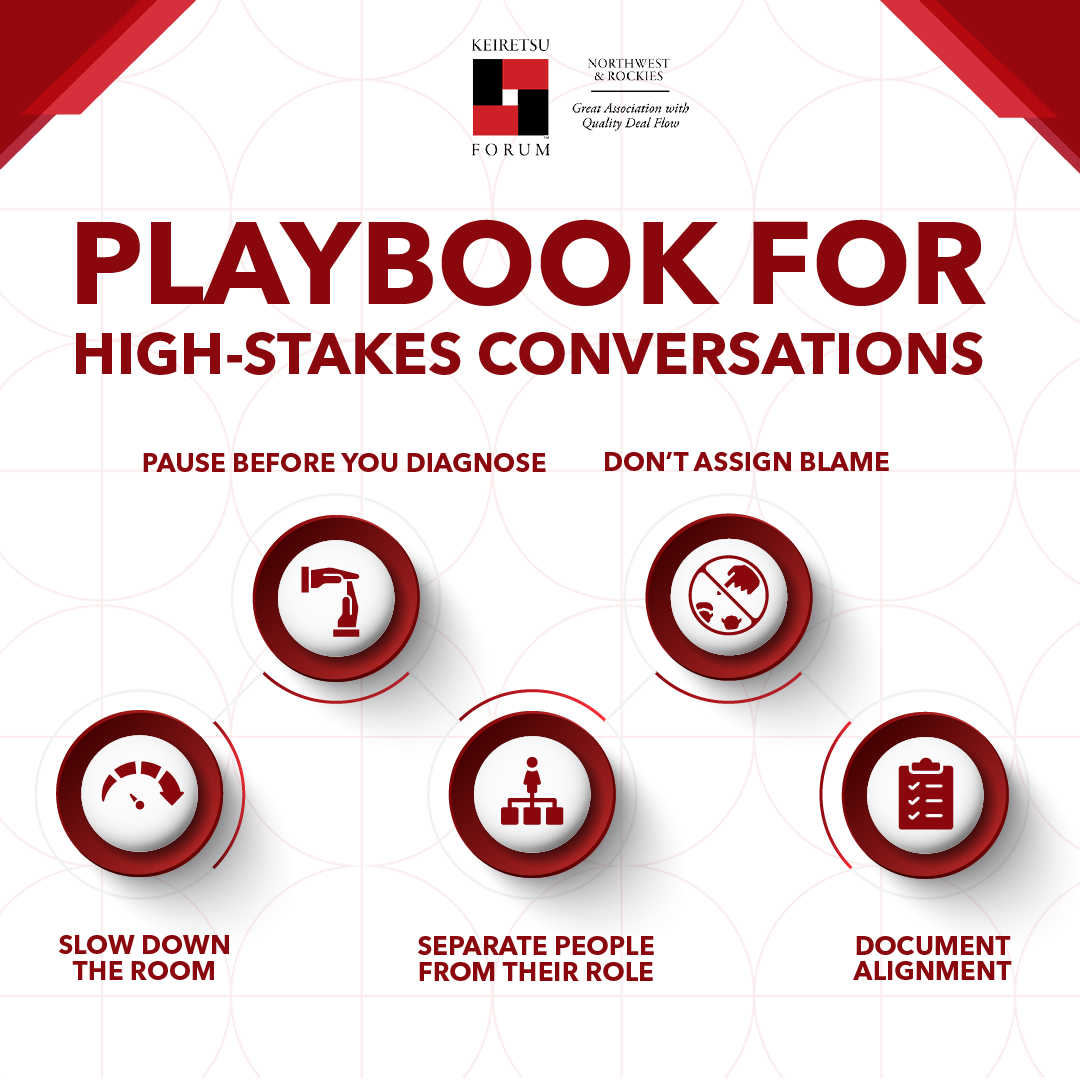
A Simple Playbook for High-Stakes Conversations
1. Pause Before You Diagnose
When tension surfaces, your first instinct is often to identify the problem and fix it. Resist that impulse.
Before diagnosing anything, ask yourself: What just triggered my reaction? What assumptions am I making right now? What information might I be missing?
That internal pause prevents you from turning a moment of stress into a moment of damage. It also models composure, something entrepreneurs often mirror, whether consciously or not.
2. Name the Tension Without Assigning Blame
Unspoken tension is far more dangerous than acknowledged discomfort. You don’t need to solve the issue immediately. You need to name it neutrally.
Use statements like “There seems to be a disconnect between expectations and execution here.” “This feels more charged than a normal performance discussion.” “I want to make sure we’re aligned before this goes further.”
By labeling the tension without pointing fingers, you create psychological safety. That safety is what allows truth to surface.
3. Ask Questions That Slow the Room Down
Questions are your most powerful tool for creating space. Ask questions like “What constraints are you operating under that we may not be seeing?” “What would success look like from your perspective over the next 90 days?” “Where do you think we’re misaligned right now?”
Now you will be able to:
- Shift the entrepreneur out of defense mode
- Turn the conversation from confrontation into collaboration
4. Separate the Person From the Role
One of the most common failures in business is the blurring of identity and responsibility. When performance feedback feels personal, entrepreneurs defend themselves rather than address the issue. You need to separate the two explicitly.
Reinforce that:
- The conversation is about the role, not the individual
- Expectations come from the company’s stage, not personal judgment
- Accountability is structural, not emotional
This distinction protects relationships while still enforcing standards.
5. Document Alignment, Not Conflict
When conversations go poorly, people rush to document to protect themselves. That’s how email threads turn into evidence.
Instead, document alignment:
- What was agreed upon
- What success looks like
- What support will be provided
- When the next check-in occurs
This creates a paper trail that reduces risk rather than amplifies it. It also signals maturity and professionalism.
Set The Tone as An Investor
As a board member or lead investor, your behavior establishes the cultural ceiling for difficult conversations. If you react quickly, others will too. If you escalate emotionally, others will follow. If you create space, you give the company permission to do the same.
There are no groups without conflict, so defuse such situations with clarity, discipline, and respect.
Anyone can communicate well when things are going right. Real governance shows up when expectations are missed, capital is tight, and trust is tested. When you master the ability to create space between stimulus and response, you will be able to turn the conflict into a strategic advantage.