
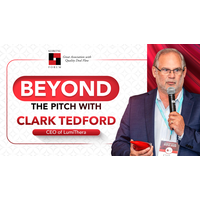
Trained as a scientist and pharmacologist, Clark spent the early part of his career in Big Pharma, working on treatments for complex neurological diseases like Alzheimer’s, Parkinson’s, and schizophrenia. But over time, the desire to take ideas from concept to patients proved irresistible.
That desire eventually led to LumiThera, a company built around a bold idea: using light-based therapy to treat degenerative eye diseases for which there were no effective treatment options. After a 12-year journey through clinical trials, regulatory hurdles, and global fundraising, LumiThera was acquired by Alcon, one of the world’s largest ophthalmology companies.
In this Beyond The Pitch conversation, Clark reflects on the long road to that exit, the realities of building in MedTech, and why knowing when to let go is as important as knowing when to start.
Clark, can you tell us what inspired you to start LumiThera?
My career started in Big Pharma as a neuropharmacologist, working on central nervous system diseases. While that environment taught me a lot, I also got exposed to the energy of startups through partnerships, and that excitement stayed with me.
Later, I joined a MedTech company where we took a drug from development into humans, took the company public, and eventually sold parts of the technology to companies like Merck and Wright Medical. That experience gets in your blood.
After another successful startup journey in Seattle, where one of our products was FDA-approved and later sold for about $1.5 billion, I joined a company developing light-based therapies for neurological disorders, including stroke. That’s where I met ophthalmologists who asked a simple question: Could this work in the eye?
At first, I said no. We were a startup and needed focus. But two years later, I revisited the idea. That conversation ultimately led to the creation of LumiThera in Washington state, focused on non-invasive, light-based therapy for degenerative eye diseases like dry age-related macular degeneration.
What made this problem worth pursuing?
Dry age-related macular degeneration affects more than 200 million people globally, and until recently, there were no effective treatments. The retina requires enormous amounts of energy, and as we age, that energy production declines, making it vulnerable to degeneration.
This is a massive unmet medical need, one that’s growing as people live longer. LumiThera’s approach was to stimulate blood flow and energy production in retinal tissue using light, without injections or invasive procedures.
From the beginning, we knew this was both scientifically interesting and clinically meaningful.
What were some of the early challenges in building LumiThera?
The first challenge was funding. Specifically, seed capital to build prototypes. LumiThera started as a concept, and we needed early resources to turn it into a real device.
Fortunately, Washington State had grant programs that supported early-stage medical innovation. Those grants allowed us to build clinical prototypes, which later helped us attract angel investors. Keiretsu Forum played an important role at that stage.
Because I’d built companies before, I understood capital comes in stages: friends and family, angels, then institutional capital. Keiretsu Forum’s due diligence process added credibility and helped us secure additional grants, including NIH funding that supported parts of our clinical trials.
Of course, we also faced COVID-19, an external shock no one could plan for. That’s part of startup life. You learn quickly that being able to pivot, communicate, and take responsibility for the people who depend on you is part of the CEO role.
How did you balance long clinical timelines with the need to generate revenue?
It’s a real challenge, especially in pharma and MedTech.
One lesson I learned early was to look beyond the U.S. first. At the time, Europe offered a more flexible regulatory path for safe medical devices. We used that to generate early revenue with key opinion leaders and to validate our business model.
Our model wasn’t a one-time capital sale, it included recurring revenue. That mattered to sophisticated investors, who want to see proof of technology and commercial viability.
Going to market early also taught us things we didn’t know. No matter how prepared you think you are, you learn once customers start using your product. Those lessons in Europe helped us prepare for the U.S. market years later.
When things get tough, what guiding belief keeps you grounded?
You have to take the long view.
There are always easier paths in the short term, but they’re not always the right ones. I try to ask myself where we want to be in 10 years—not in six months. That perspective helps you make better decisions, especially when pressure is high.
Fear of failure isn’t necessarily bad. In fact, it can sharpen your focus and drive you to succeed. As a founder, you wear many hats. You do what needs to be done.
How did you maintain trust with investors over a 12-year journey?
Transparency. During COVID, for example, we increased communication with investors. Silence creates anxiety. Regular, honest updates build trust.
I’ve always maintained an open-door policy. It takes time, especially with a large investor base, but it’s necessary. Investors are partners in a long journey, not just sources of capital.
Do you believe entrepreneurship is something you’re born with—or something you can learn?
I definitely believe it can be learned.
When you’re coming out of school, you often don’t even know what opportunities exist. Large companies provide a foundation. They teach process, discipline, and structure. But the entrepreneurial instinct often stays dormant until you’re exposed to startups.
For me, that “gene” activated during my first startup. I learned from people who had done it before, made mistakes, adjusted, and gradually came to understand that, while every company is different, there is a repeatable framework, especially for managing risk in long-cycle industries like MedTech and pharma.
If you had to distill your journey into a few lessons for other entrepreneurs, what would they be?
First, it’s hard. It takes longer and costs more than you expect.
Second, if you’re successful, it’s gratifying to see patients benefit and investors proud of what they supported.
And third, these companies become your babies, but at some point, you have to let them grow up.
Knowing when to exit is one of the hardest decisions founders face. In LumiThera’s case, Alcon had the global reach to take the technology further than we ever could alone. Letting go wasn’t easy, but it was the right decision.