
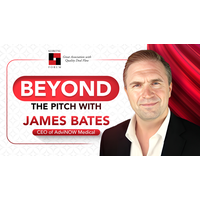
When James Bates started talking about artificial intelligence in healthcare, most people weren’t sure about his vision. Clinics questioned the tech’s need. Investors weren’t convinced. And in 2019, just as AdviNOW Medical finally reached the market, a global pandemic shut down the company’s primary customer base.
Today, AdviNOW is recognized by TIME as one of the world’s top health tech innovators, and James Bates sits at the forefront of AI-enabled clinical automation.
In this Beyond The Pitch conversation, he talks about early struggles, his path from self-driving tech to healthcare, and the values that continue to shape his entrepreneurial story.
James, could you tell us about some of the early challenges you faced as a founder, and how you navigated them?
When I founded AdviNOW Medical, AI wasn’t a buzzword—especially not in healthcare. People wondered if it would replace doctors. Some were skeptical, others were worried. We launched our product in December 2019, and two months later, COVID shut down all 27 Safeway clinics using our system. That was devastating because retail clinics were our main customer base.
We had to pivot overnight to hospital systems. That meant reconfiguring the platform to work across any clinical workflow. It was painful, but it taught me something important: you must be ready for anything and readiness comes from having enough capital and enough resilience to survive anything.
What inspired you to start AdviNOW?
Before AdviNOW, I ran a billion-dollar company in self-driving vehicle technologies. We powered the systems behind Tesla, Daimler, GM, and Google Waymo. After we sold, my non-compete led me to move into a completely new industry.
I explored buying medical practices, but most were barely profitable. One doctor said, “James, I know my business is struggling; I need someone to fix it.” So I approached it like an engineer. I did a Six Sigma time-motion study, literally sitting in clinics with a stopwatch, measuring every step.
What I found shocked me: doctors spent 70% of their time doing tasks that didn’t require a medical license, such as documentation, insurance, compliance. Only 30% was actual patient care. And that 70% was exactly where AI could help. That’s the foundation of AdviNOW: automating the administrative burden so doctors can practice medicine again.
Was there someone who influenced your entrepreneurial journey the most?
I’m inspired by people like Elon Musk and Jeff Bezos. They build with pure focus. They aren’t interested in incremental improvements; they aim to reinvent industries. Their narrow, stubborn focus is something I admire and relate to. My hope is that AdviNOW can bring the same level of disruption to healthcare.
What core values guide you as a founder and CEO?
I hire and lead based on three things:
- High intellect – I want people smarter than me.
- The right attitude – people who care about results, not optics.
- High integrity – doing what’s right, even when no one’s looking.
These traits build a culture that delivers results. We’re not just trying to build a business, we’re trying to transform a trillion-dollar market while creating meaningful societal impact.
AdviNOW was recently recognized by TIME as one of the world’s top health tech companies. How do such recognitions impact your work?
Recognition from TIME is validating, of course. But the real validation comes from customers. For instance, Dr. Farford from Mayo Clinic wrote us a recommendation letter saying AdviNOW represents a “paradigm shift” in patient care. That means more to me than any headline. Media recognition opens doors; customer impact keeps them open.
Let’s talk about the 80-20 rule. What 20% of your effort brings 80% of clarity in decision-making?
For us, it’s automation. Our mission is to eliminate clicks, eliminate data entry, and allow AI to handle patient engagement. Our system mimics four brains: a doctor’s for diagnosis, a payer’s for insurance documentation, a lawyer’s for compliance protection, and an engagement brain for guiding patients.
Unlike general-purpose AI like ChatGPT, our system is built solely on peer-reviewed medical literature, validated and ranked by expert physicians. That makes it reliable, consistent, and safe in clinical environments.
And what about applying the 80-20 rule to yourself?
My 20% is strategic direction. I shouldn’t be doing engineering or sales; I’ve hired great people for that. I focus on the relationships, systems, and structures that help my teams operate at maximum productivity.
Rejection is a big part of fundraising. How do you handle it?
You don’t get what you want unless you ask, and when you ask, people can say no. Angels are personal investors, they have passions, limits, and biases. I had to learn to tailor the pitch to each individual and not take rejection personally.
Any advice for entrepreneurs pitching to angels?
Keep it simple. Founders love explaining complicated details, but angels aren’t experts and won’t become experts. Your pitch should make them connect with your idea immediately.
Do you have criteria for choosing investors?
I’ve learned there’s no such thing as bad networking. Even if someone can’t invest, if they’re excited about what you’re doing, they might introduce you to the right person. Treat every interaction as valuable.
A few rapid fire questions, fill in the blank — Keiretsu Forum is…
Unique, especially among angel groups.
Three words that define an entrepreneur.
Persistent. Passionate. Long-suffering.
If you could have dinner with any innovator?
Warren Buffett, Jeff Bezos, Elon Musk, or Steve Jobs. Visionaries who see what should be, not what is.
One book you’d recommend to entrepreneurs?
Good to Great by Jim Collins.