
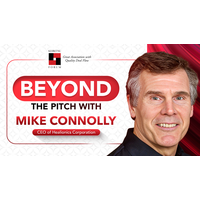
When Mike Connolly talks about medical innovation, he doesn’t start with technology; he begins with people.
After 35 years in the medical device industry as an entrepreneur, investor, and CEO, Connolly has seen firsthand how long it can take for meaningful breakthroughs to reach patients. Today, as CEO of Healionics Corporation, he’s focused on a problem that has plagued healthcare for decades: safe, reliable access to the bloodstream for dialysis patients.
In this Beyond The Pitch conversation, Connolly reflects on his journey in medical devices, the long road to de-risking breakthrough technologies, and why persistence, not speed, is often the defining factor in healthcare innovation.
Mike, could you give us a quick introduction to yourself and the company you’re building?
I’ve been in the medical device industry for about 35 years, working as an entrepreneur, a venture capitalist, and a CEO. I joined Healionics Corporation roughly a decade ago because I believed deeply in the company’s platform biomaterial technology and its potential to improve patient lives, particularly for people with kidney failure who require dialysis.
Healionics Corporation has developed a novel synthetic blood vessel, also known as a vascular graft, that’s used to access the bloodstream for dialysis. Dialysis itself is a mature process, but accessing the bloodstream remains incredibly difficult. Even after 60 years of experience, current solutions frequently fail due to clotting and infection. Our vascular graft has shown in advanced clinical trials that it can resist both occlusion and infection - the two leading causes of failure in this space.
What makes this problem so significant for patients?
There are about 550,000 dialysis patients in the U.S. alone. Most undergo dialysis three times a week, sitting in a clinic for three to four hours each session. While filtering blood is well understood, creating and maintaining a reliable access point to the bloodstream remains a significant challenge.
The synthetic blood vessels currently on the market tend to clog quickly, and infections are common and often life-threatening. Our graft has demonstrated the ability to reduce both of those risks significantly. We’ve also received Breakthrough Device designation from the FDA, which accelerates both our regulatory and Medicare pathways. We’re now preparing for our pivotal clinical trial, the final step before FDA approval.
Looking back, what were some of the early challenges you faced while building Healionics Corporation?
When I joined Healionics Corporation, the vascular graft was still at the early animal-study stage. Since then, we’ve conducted roughly 20 extensive studies and completed three clinical trials. Each time you enter human trials, you learn something new. Minor design refinements arising from early trials led to major performance improvements later on.
The results from our third clinical trial were powerful. They were recently presented at a major clinical conference by one of the most experienced vascular access surgeons in the world, who is also a founding member of the Vascular Access Society of the Americas.
A common challenge for companies like Healionics Corporation is focus. When you have a powerful platform technology, there are often multiple possible applications. The company’s first commercial success was actually in glaucoma, where the biomaterial has been implanted in more than 7,000 patients in Europe over the last 13 years. That business has since spun out, allowing Healionics Corporation to focus entirely on vascular access.
Getting medical devices to market takes time, persistence, and patience. But today, we’re past the point of major technical risk. The device has been de-risked through extensive animal and clinical testing. Now, it’s about executing toward FDA approval.
What originally drew you to Healionics Corporation if you didn’t start the company yourself?
Healionics Corporation was founded in 2007 as a spin-out from the University of Washington by Andrew Marshall, who co-invented the Star biomaterial with his thesis advisor, Professor Buddy Ratner. By the time I joined in 2016, the team had already proven the technology’s value across multiple applications.
They had shown success in glaucoma patients and strong results in controlled animal studies for other indications. I felt confident that this was a platform with real staying power. The vascular graft was the natural next product, and beyond that, there’s a broader pipeline we can pursue once this reaches the market.
What’s the common thread that defines your entrepreneurial DNA?
I’ve always been drawn to unsolved medical problems and applying technology to solve them. Larger companies tend to wait for innovation to emerge elsewhere, then acquire it. My work has almost always been at the earliest stages: helping turn ideas into companies, assembling teams, raising capital, and navigating the long bench-to-animal-to-clinical pathway.
In medical devices, success isn’t just about proving that something works. You also need regulatory approval, and in the U.S., you need reimbursement. Hospitals have to get paid to use your product. All of those elements have to align for a company to succeed.
When things get tough, what belief keeps you pushing forward?
Helping people. I spent 11 years in the Navy, and that service mentality stayed with me. Medical devices are a meaningful field because you know your work directly improves lives.
In our fundraising conversations, it’s common for people to share personal connections to dialysis, either they’re on it themselves, or someone close to them is. Kidney disease affects about 14% of the population, and many don’t realize it until they reach kidney failure. When that happens, dialysis becomes a sudden and life-altering reality. Knowing that we can make even one part of that process safer and less painful is a powerful motivator.
Having been both an entrepreneur and an investor, what separates founders who get funded from those who don’t?
Strong planning, clear communication, and the ability to assemble the right resources, especially people. But above all, resilience. Starting a company is hard. Starting a medical device company is even harder. The pathway is often longer, and the need for course corrections is inevitable.
Founders who succeed are willing to adapt, sometimes even changing direction entirely, while continuing to push forward.
How do you keep investors engaged and informed?
We prioritize transparency and communication. We provide detailed quarterly updates, and sometimes more frequently when there’s meaningful news. We’re very deliberate about sharing accurate, honest information, both successes and challenges.
It takes effort, but it builds trust, and that trust compounds over time.
If you had to distill your journey into one lesson for other entrepreneurs, what would it be?
Persistence. You will face significant challenges, and you may have to change direction more than once. Some of the most successful companies I’ve been involved with ended up very different from their original vision. The key is staying committed long enough to find the right path.