
In early-stage investing, the difference between conviction and miscalculation often comes down to how accurately you understand the customer. Founders build with belief. Investors back that belief. But customers? They decide based on something far more grounded—perceived value versus perceived risk. And more often than not, those perceptions are wildly misaligned.
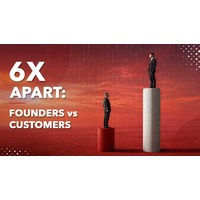
Ben Pidgeon, Executive Director at VisionTech Partners, in his keynote speech at the Investor Capital Expo, called this the 6X gap - a fundamental disconnect between how founders see their product and how customers evaluate it.
The concept is very simple, based on a 2012 Harvard Business School article by Steve Blank. Founders tend to overestimate the benefits of their product by a factor of three. Customers, on the other hand, overestimate the cost of switching by roughly the same margin. The result is a sixfold gap between expectation and reality. And in that gap lies the reason why so many promising startups struggle to gain traction despite strong teams, large markets, and significant funding.
At first glance, this might seem counterintuitive. If a product is objectively better, faster, cheaper, or more efficient, shouldn’t adoption follow naturally? In theory, yes. In practice, no.
Why Customers Don’t Switch (Even When Products Are Better)
Customers don’t make decisions in a vacuum. They operate as per their habits and risk tolerance. The status quo, however imperfect, seeks familiarity.
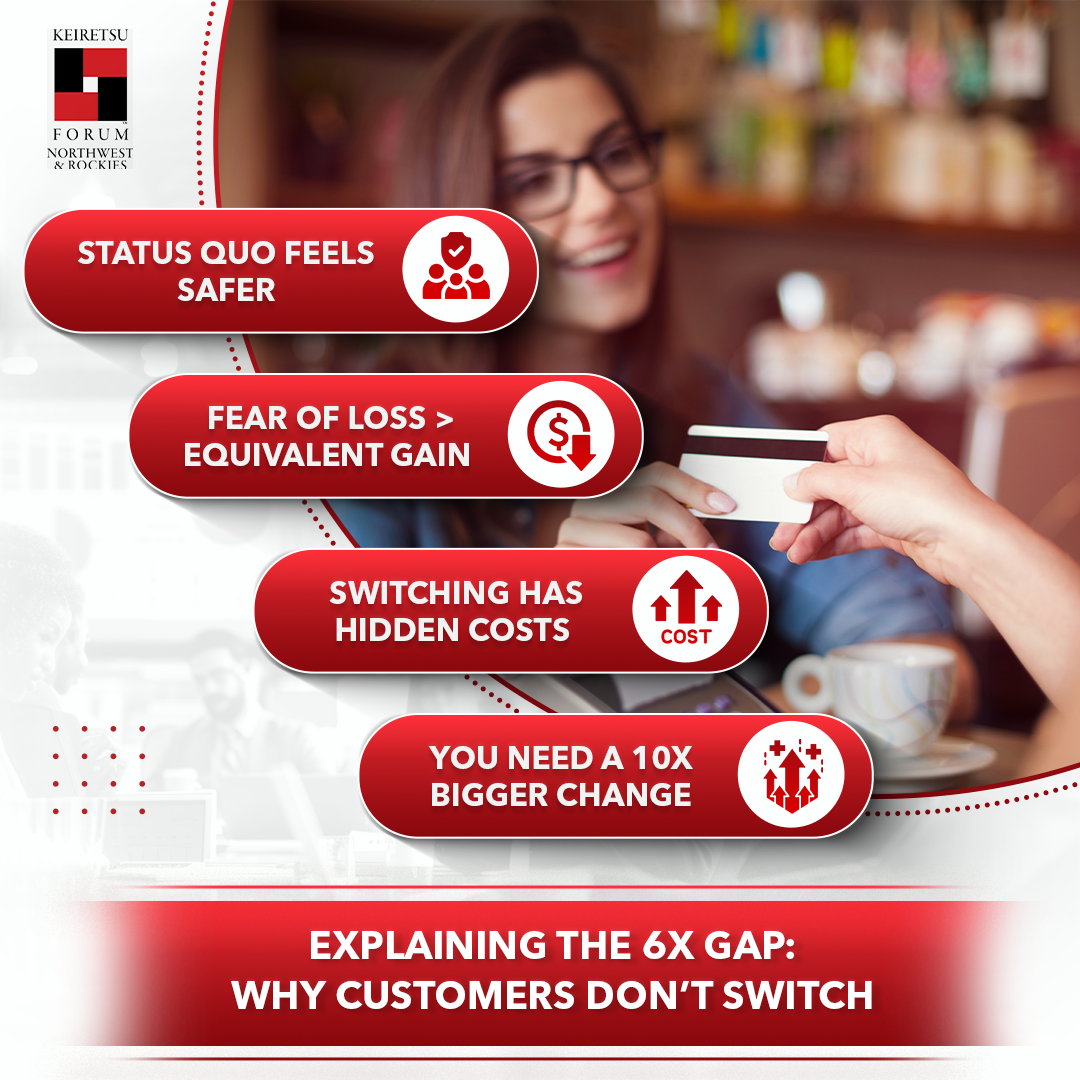
Behavioral economics gives us a useful lens here. Studies consistently show that people weigh losses two to three times more heavily than equivalent gains. This principle, known as loss aversion, plays out clearly in purchasing decisions. A new solution might promise a 20% improvement, but if adopting it introduces uncertainty, learning curves, or potential disruption, customers start to hesitate. Not because the product lacks value, but because the perceived risk outweighs the incremental gain.
This is why “better” is rarely enough. To drive real behavior change, a product needs to be not just incrementally better, but meaningfully superior, often by an order of magnitude. In other words, customers aren’t looking for improvements. They’re looking for outcomes that justify the cost of change.
The 10X Expectation: What It Really Takes to Drive Adoption
Consider a mid-level manager using an established CRM system. A startup comes along offering a solution that’s 20% more efficient or slightly cheaper due to AI-driven automation. On paper, it’s a strong value proposition. But in reality, switching involves retraining teams, migrating data, adjusting workflows, and risking short-term disruption. Unless the new solution delivers a step-change improvement, something closer to 10x than 1.2x, the manager is likely to stick with what already works.
This gap between perceived benefit and perceived cost is where many startups falter. Founders, deeply immersed in their product, see its potential in its best light. They understand the technology, the roadmap, and the long-term vision. Customers, however, evaluate the product in the context of their current reality—their workflows, constraints, and competing priorities.
The Problem Isn’t the Product, It’s the Customer Need
The misalignment becomes even more pronounced during fundraising. Strong narratives, compelling demos, and large market opportunities can create a sense of inevitability around a startup’s success. Investors, influenced by these signals, may underestimate the friction involved in actual customer adoption. The assumption is that if the product is good enough, the market will respond.
But markets don’t respond to potential. They respond to validated demand.
A useful way to reframe this is to shift focus from the product to the problem. Customers don’t buy features; they buy solutions to specific pain points. And not all pain points are created equal.
There’s a meaningful difference between what might be called a “mosquito bite” problem and a “shark bite” problem. A mosquito bite is mildly irritating. It’s noticed but rarely acted upon. A shark bite, on the other hand, demands immediate attention.
Startups that succeed tend to anchor themselves in shark bite problems - issues so acute that customers are actively seeking solutions, allocating budget, and willing to endure the friction of change. Startups that target mosquito-bite problems often struggle, regardless of how elegant their solutions may be.
The Before-and-After Test
Another critical lens is the “before and after” state. What does the customer’s world look like without the solution, and how materially does it improve with it? If the delta isn’t significant, the 6X gap remains intact—and adoption remains unlikely.
This is where many founders unintentionally blur the line. They articulate a compelling future but fail to quantify the present. Without a clear baseline, even meaningful improvements can feel abstract to customers.
Closing the Gap
Ultimately, the 6X gap is not just a product problem; it’s a perception problem. And closing it requires more than better technology. It requires a deep understanding of customer behavior, a willingness to challenge assumptions, and a disciplined approach to validation.
For founders, this means slowing down—resisting the urge to build before fully understanding the problem. For investors, it means looking beyond surface-level signals and digging into the reality of customer demand.
Because in early-stage ventures, success isn’t determined by how strongly a founder believes in their product. It’s determined by how urgently a customer needs it.