

If you've felt like the past few years of investing have been harder to read than usual — markets swinging on sentiment as much as fundamentals, institutions you once trusted losing credibility, the rules of the game seemingly rewritten overnight — you're not imagining it. According to Ben Spievak, founder and CEO of SVRN, there's a reason for that feeling, and it's been hiding in plain sight throughout history.
At the Rockies Investor Capital Expo on June 18, 2026, Spievak laid out a framework drawn from the book The Fourth Turning, authored by Neil Howe and William Strauss, which studies roughly 80-to-100-year cycles (the length of a long human life) that recur across major civilizations, from Rome to Imperial China to the United States today. Each cycle breaks into four distinct seasons, or "turnings."
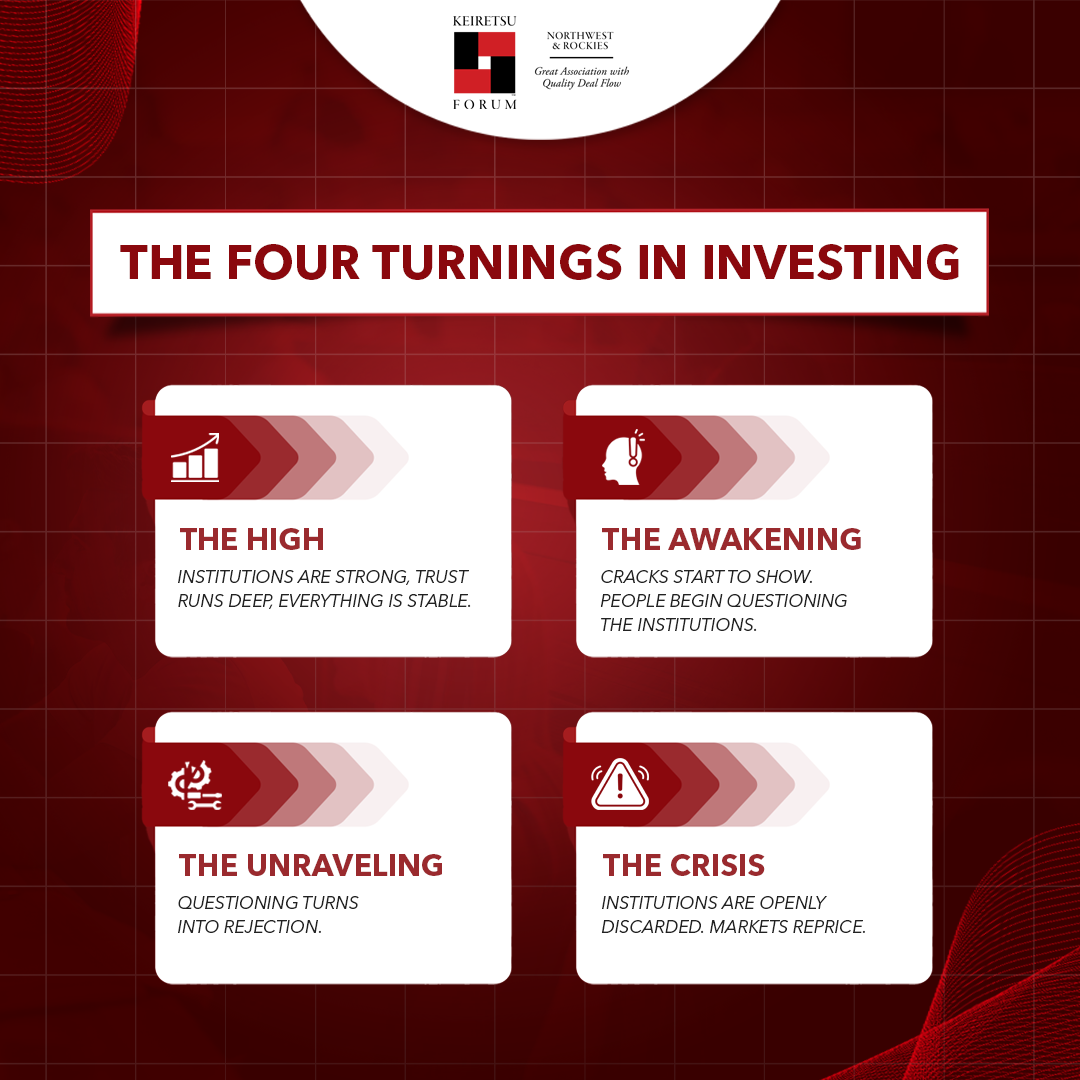
The High. Institutions are strong, trust runs deep, and the economy, society, and political environment feel stable. Confidence is the default setting.
The Awakening. Cracks start to show. People begin to question the institutions and incentive structures that their world is built on. The structure's integrity is tested for the first time.
The Unraveling. Questioning turns into rejection. The fabric of society begins to fray, and the early signs of decline become visible to everyone, not just the skeptics.
The Crisis. Institutions are openly discarded. Markets reprice. Things break down — not because something has gone wrong, but because the old assumptions simply can't hold anymore. This is where Spievak believes we are right now, in a window he places between 2020 and 2045.
Here's the part worth pondering: a crisis period isn't the end of anything. It's an incubator. It's the phase where the foundation for the next hundred years gets laid, and where the decisions made today — what gets built, what gets funded, what gets believed in — carry outsized weight.
Reframing Volatility
This is where the framework becomes genuinely useful for how you think about your portfolio. The instinct, when markets swing hard, is to read that swing as risk or chaos. Spievak suggests a different lens: what looks like instability is often just the market finding a new price. Public markets, private markets, crypto — all of it is recalibrating around what value means in a world that's operating on a different set of assumptions than the one we grew up with.
Consider the numbers he cited: in 2025, AI captured 61% of global venture capital — roughly $258 billion. By the first quarter of this year, just four companies absorbed 65% of all global VC. That kind of concentration isn't normal market behavior. It's capital openly voting on where the next era is headed, even while plenty of "old world" assumptions — from pension-backed labor models to legacy valuation multiples — visibly strain under pressure.
What This Means for How You Invest
If the old definitions of value are breaking down, the natural next question is: what holds its value when so much else is being repriced? Spievak's answer leans on scarcity. When AI can generate unlimited code and unlimited content, those things stop being scarce — and stop being the differentiator they once were. What remains scarce, he argues, are hard assets, real human attention, and genuine relationships and trust — things that simply can't be scaled the way software can.
That's not a reason to abandon return-driven thinking. It's a reason to ask a sharper question before you write a check: is this something that compounds in value precisely because it can't be replicated at scale?
For investors trying to make sense of a market that often feels irrational, the Fourth Turning offers something rare — not certainty, but context. Volatility stops looking like noise and starts looking like signal. And once you can see the shape of the cycle, the next move becomes much easier to call.