

On December 12, 2025, the U.S. House passed an act that got the angel investors and entrepreneurs leaning forward at once. The INVEST Act (Incentivizing New Ventures and Economic Strength Through Capital Formation Act) is a broad capital-formation package that aims to make it easier for early-stage companies to raise money and for more investors to participate in private markets.
The INVEST Act recognizes a fundamental problem: our investment rules haven't kept pace with economic reality. The number of publicly traded companies in America has plummeted from roughly 8,800 in 1997 to fewer than 4,000 in 2024. Meanwhile, many of tomorrow's most exciting companies (such as SpaceX and OpenAI) remain private longer, effectively excluding everyday investors. At the same time, wealth accumulates in the hands of those already wealthy enough to qualify as "accredited investors."
Now, more than a decade later, Congress is taking another swing at modernizing investment regulations.
Who Gets to Invest? Expanding the Accredited Investor Definition
Here's where things get interesting for both investors and entrepreneurs. Under current law, to invest in most private companies, you need to be an "accredited investor", basically someone with either $1 million in net worth (excluding your primary residence) or $200,000 in annual income ($300,000 for couples). These thresholds were set decades ago and have never been adjusted for inflation. The result? A 30-year-old Harvard MBA earning $150,000 doesn't qualify, but someone who inherited wealth with no financial knowledge does.
The INVEST Act proposes to blow this system wide open. Rather than making wealth the sole criterion, the legislation would allow individuals to qualify as accredited investors based on professional expertise, education, or experience. This could include individuals with industry licenses, those registered with organizations like FINRA or the SEC, or those who meet specific work-experience benchmarks.
The Act would require the SEC to create an exam or certification process. Pass this test, and you could become an accredited investor regardless of your income or net worth. It's essentially a knowledge-based pathway to investment access. If you can demonstrate you understand the risks, you're in.
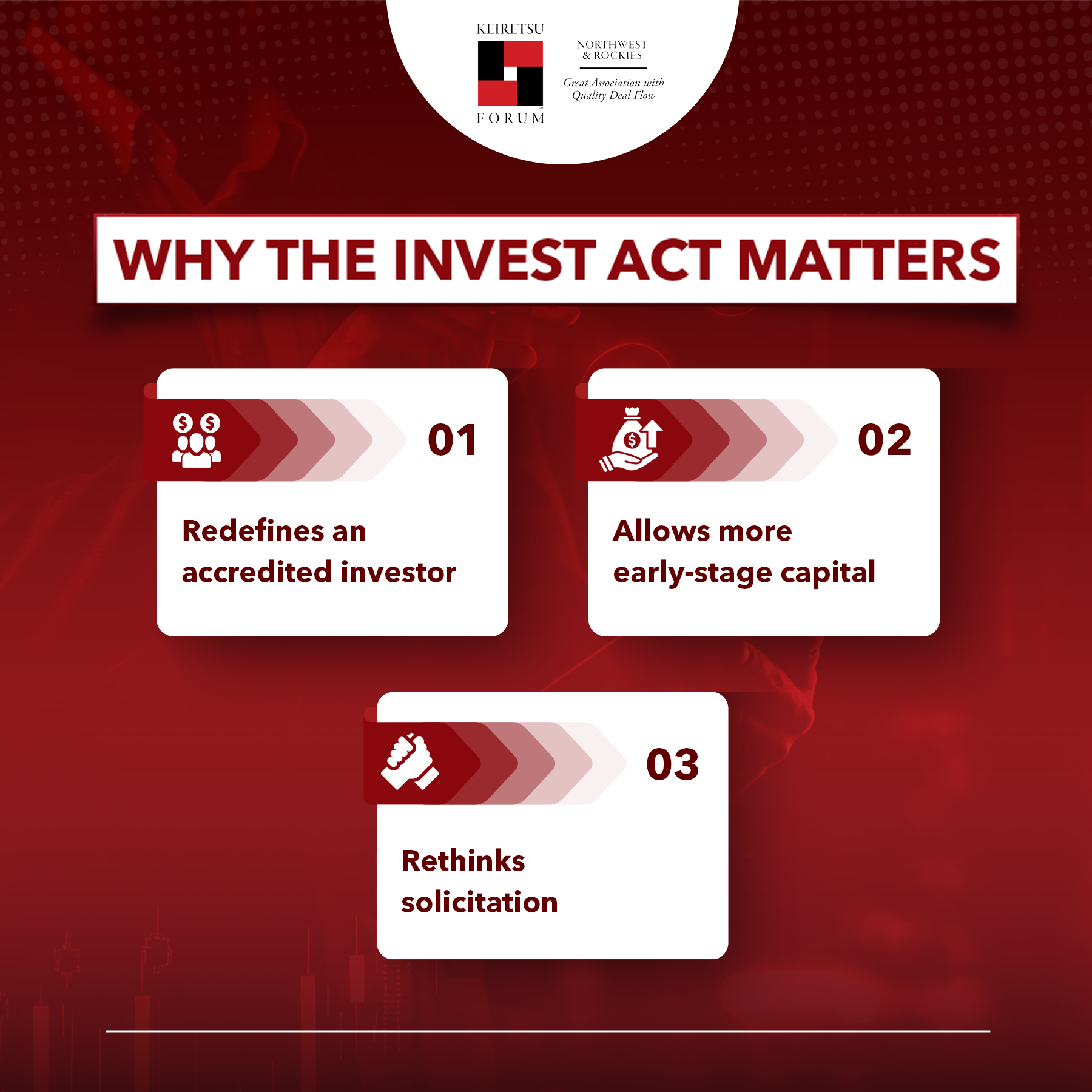
More Capital for Early-Stage Companies
The INVEST Act doesn't stop at redefining who can invest. It also raises the thresholds for how much capital companies can raise under various exemptions.
For crowdfunding campaigns, the threshold requiring an accountant review increases from $100,000 to $250,000, with discretion up to $400,000. This matters because an accountant review costs money and time, expenses that can be prohibitive for bootstrapped startups. By raising this threshold, the Act makes it easier for early-stage companies to tap the crowd without incurring excessive compliance costs.
Perhaps most significantly for venture-backed startups, the Act expands the definition of qualifying venture capital funds. The size limit jumps from $10 million to $50 million, while the investor cap increases from 250 to 500. This means more funds can operate under the venture capital exemption and accommodate more limited partners. Translation: more institutional capital flowing into startups, with less regulatory friction.
The legislation also raises the exemption threshold under the Investment Advisers Act from $150 million to $175 million, with future inflation indexing. This reduces regulatory burden on smaller investment advisers who often work with angel investors and emerging fund managers.
Rethinking General Solicitation
One of the more subtle but potentially transformative provisions involves how businesses can pitch to investors. Currently, if you're raising capital under Regulation D (the most common exemption for private offerings), you generally can't engage in "general solicitation”, meaning you can't broadly advertise your fundraise.
The INVEST Act would direct the SEC to revise these rules to permit presentations at "specified sponsored events" such as universities, nonprofits, angel investor groups, and accelerators without labelling such communications as general solicitation. This move is significant for entrepreneurs seeking visibility. Imagine being able to pitch at your university's demo day or at an established angel group's monthly meeting without worrying about violating securities law. That's the practical change that could help promising companies find the right investors faster.
The Road Ahead
Before you get too excited, remember that the INVEST Act has only passed the House. It now sits in the Senate Banking, Housing, and Urban Affairs Committee, where its future is uncertain. Some lawmakers, particularly those concerned about investor protection, may resist provisions they view as weakening safeguards. The bill could pass as-is, be significantly modified, be folded into a larger economic package, or die in committee.
If it does become law, implementation won't happen overnight. The SEC would need to write rules defining what qualifies as relevant "professional expertise," design the certification exam, and update various regulatory frameworks. It could take months or even years.
Bottom Line: Patience and Preparation Will Be Key Moving Forward
If you're an angel investor who doesn't currently meet the accredited investor threshold, the INVEST Act could open doors for investment. You might qualify through professional credentials or by passing the new SEC exam.
For entrepreneurs, a broader accredited investor base means more potential angels, more competitive terms, and potentially faster fundraising cycles. When capital is more accessible, you have more leverage in negotiations.
But these changes won't come overnight, so keep an eye out for new developments and prepare a plan if the INVEST Act is ultimately finalized. The economics of early-stage investing could look very different in the near future, and those who understand the shifting landscape will be best positioned to benefit.
References:
https://www.irafinancial.com/blog/invest-act-accredited-investor/