

You saw a good opportunity and struck a deal. Fast forward eighteen months after the investment, and the board meeting is tense. Milestones slipped. A key hire didn’t work out. Cash runway is tighter than expected. The conversation keeps circling the same question: Why didn’t we see this coming?
The uncomfortable answer is usually the same, because the real signals were never in the deck. They showed up earlier, in how the entrepreneur handled disagreement, processed feedback, and responded to uncertainty. Those coaching signals are easy to overlook in diligence, but they’re often the earliest signals of execution failure.
People diligence isn’t limited to gut feel or charisma. It’s about observing how an entrepreneur processes reality. Amy L Brodsky, CEO at Sky Partners, talked briefly about this topic in her keynote ‘The Habit High Performers Master: Embracing Difficult Conversations’ at the Investor Capital Expo in August 2025.
This blog highlights the green flags and red flags in entrepreneurs that quietly signal how easy it is to work with someone and how they will handle challenges.
Why Coaching Signals Matter More Than Confidence
Early-stage companies go through many pivots. That’s because they are learning systems and they need to adapt to the industry’s needs. Hence, strategy shifts, market pushback, talent gaps emerge, and capital may become thin.
In that environment, the most valuable trait in leadership is to take feedback and learn quickly. An entrepreneur who can update beliefs, integrate dissent, and course-correct without ego erosion will be best placed for success.
Spotting these qualities in the early conversations can make or break your deal.
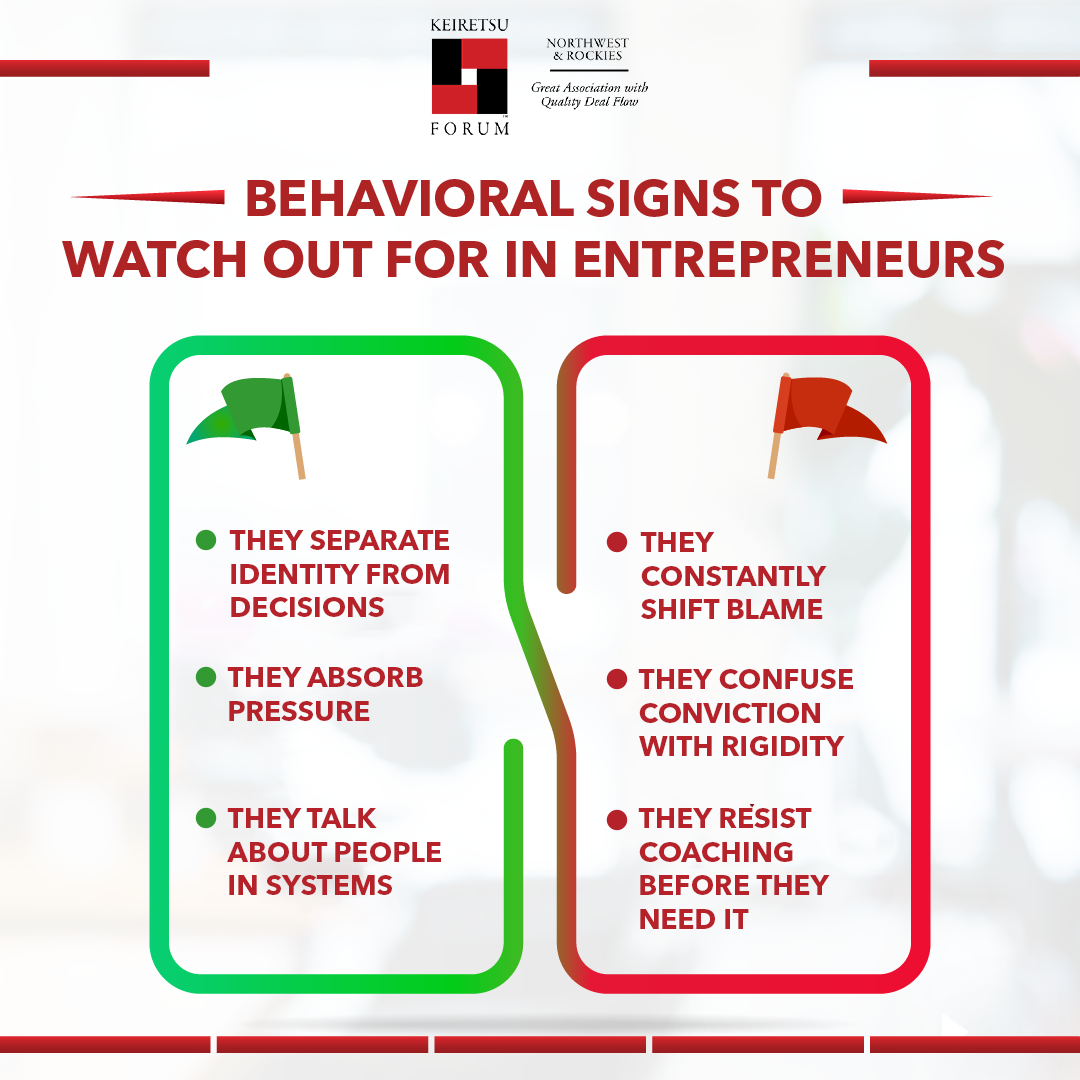
Green Flag #1: They Separate Identity From Decisions
Watch how entrepreneurs talk about their choices.
Strong coaching signals show up when an entrepreneur can say, “I was wrong about that.” “That assumption didn’t hold once we saw customer behavior.”
They critique decisions, not themselves, and they don’t get defensive when others do the same.
This separation matters because companies grow by anticipating obstacles and adapting to change. Entrepreneurs who tie their identity to being “right” will unconsciously resist the very feedback that growth requires.
Red Flag #1: They Shift Blame to Others
Execution risk spikes when every setback has an external explanation.
Listen carefully for patterns:
- Customers “weren’t ready.”
- The market “shifted unexpectedly.”
- Hires “didn’t execute as promised.”
- Investors “didn’t understand the vision.”
Occasional context is normal. Constantly shifting the blame is not a quality you desire in a leader.
Entrepreneurs who cannot own up to mistakes early will rationalize bigger ones later. Over time, this erodes accountability across the company and eventually lands on your board agenda as a “culture problem.”
Green Flag #2: They Invite Tension, Not Just Validation
Strong leaders are prepared for confrontation and approach such situations sensibly.
During diligence conversations, notice whether the entrepreneur asks you where you disagree, explores downside scenarios without prompting, and pushes past surface-level praise.
The strongest coaching signal is curiosity under challenge. When entrepreneurs lean forward instead of shutting down, they’re signaling a strong sense of security - the foundation of adaptive leadership.
Red Flag #2: They Confuse Conviction with Rigidity
Conviction is necessary. Rigidity is dangerous.
A subtle red flag appears when entrepreneurs dismiss alternative views too quickly, frame dissent as a lack of vision, and treat questions as threats rather than inputs. In such a case, you are dealing with someone who gets defensive too quickly and does not appreciate constructive criticism.
You can identify this trait in the first few conversations by asking them about industry uncertainties, consumer behavior, or any factors that could pose a challenge to the company. Their response will reveal their mindset and how open they are to pivoting when the business demands it.
Green Flag #3: They Talk About People in Systems, Not Silos
Listen to how entrepreneurs describe their teams.
Strong signals sound like “We realized our incentives were misaligned.” “Our onboarding process wasn’t setting leaders up to succeed.” “We had the right talent but the wrong structure.”
Weak signals sound like “That person just couldn’t cut it.” “We need better people.” “Execution failed because of one bad hire.”
Entrepreneurs who think systemically about people scale organizations. Those who blame individuals repeat the same mistakes with new faces.
Red Flag #3: They Resist Coaching Before They Need It
Ironically, the most dangerous entrepreneurs often look the most confident early.
Watch for subtle resistance to coaching:
- Over-talking mentors
- Selectively implementing advice
- Treating guidance as optional rather than additive
If an entrepreneur resists coaching when the stakes are low, they will reject it when the stakes are existential.
How to Incorporate People Diligence Into Your Process
Very honestly, you don’t need new frameworks to identify strong leaders. Just be a bit more observant.
Consider these practical methods when you talk to them for the first or second time:
- Ask about a decision that didn’t work and what changed afterward
- Probe how past advisors influenced outcomes
- Challenge one core assumption and watch the response, not the answer
- Notice how entrepreneurs talk about former colleagues
The goal isn’t to judge character. It’s to assess execution resilience.
Final Thought: Bet on The Right People
The one constant in early-stage investing is uncertainty. And uncertainty exposes leadership behavior faster than strategy. If you want fewer surprises post-check, spend less time perfecting the spreadsheet and more time studying how entrepreneurs respond when their thinking is tested.
And that’s the diligence most angels are still skipping.