

For decades, the mythology of startup success has centered on co-founders’ complementary skill sets, shared risk, and collective resilience. But Carta’s latest Solo Founders Report signals a structural shift: the solo founder is no longer the exception. In fact, they are rapidly becoming a defining force in the early-stage ecosystem.
Drawing on data from tens of thousands of U.S. startups, the report paints a nuanced picture of growth, opportunity, and persistent challenges for single-founder companies. For early-stage entrepreneurs and angel investors, the implications are significant.
A Structural Shift In How Startups Are Formed
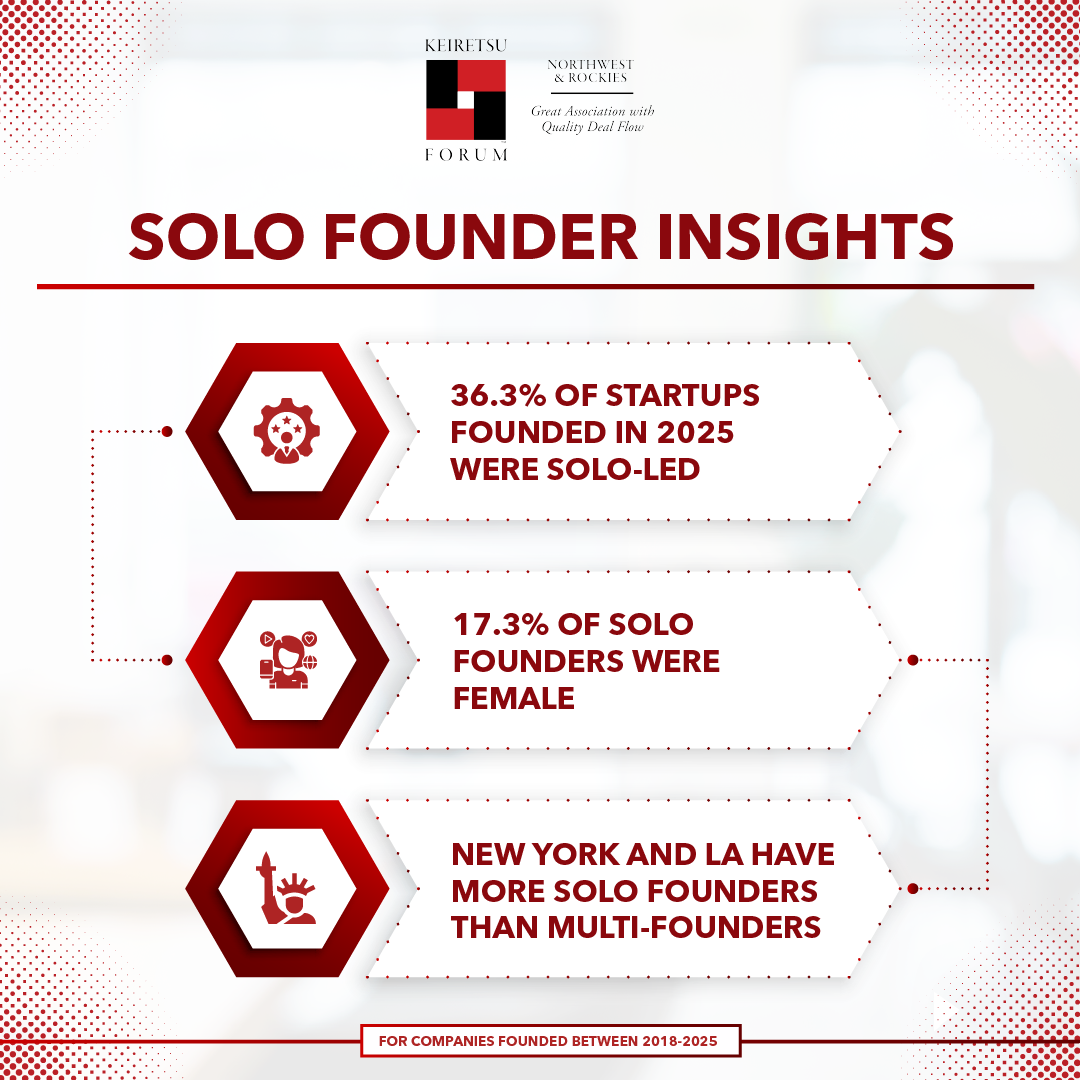
Solo founders now represent a growing share of new startups. Carta data shows that the percentage of new companies started by a single founder rose from about 23.7% in 2019 to 36.3% by the first half of 2025, essentially more than one in three startups.
The trend is even more striking over a longer horizon: solo-led startups have more than doubled over the past decade, reaching roughly 35% of new incorporations in 2024. Advances in technology, especially AI, have lowered the cost and complexity of building and launching products, allowing individuals to accomplish what once required teams. The cultural narrative of entrepreneurship has also evolved, with more founders choosing independence over early equity dilution or co-founder risk.
Fundraising: Rising Presence, Uneven Capital Access
Despite their growing numbers, solo founders still face structural headwinds in fundraising. In 2024, they accounted for roughly 35% of startups incorporated, but only about 17% of those that successfully closed a venture round within the year.
Capital allocation tells a similar story. Solo-led companies represented a meaningful share of startups but captured just 14.7% of the cash raised in priced equity rounds in 2025, even as their share of venture dollars gradually increases.
The gap reflects a persistent investor bias toward founding teams. Larger founding groups are often perceived as less risky due to complementary skills, shared accountability, and execution capacity.
Operating Dynamics: Speed, Ownership, and Hiring
Solo founders naturally operate differently from multi-founder teams. Carta data show they tend to hire earlier, bringing on their first employee 399 days after incorporation, compared with 480 days for multi-founder companies.
The faster hiring decision reflects both necessity and strategy. Without co-founders to share responsibilities, solo leaders often build teams sooner to fill capability gaps in product, go-to-market, and operations.
Ownership dynamics are also different. Solo founders typically begin with concentrated equity and decision-making power, but dilution follows the same fundraising realities as any other early-stage company. More broadly, founder ownership declines significantly across rounds, underscoring the trade-off between control and growth capital.
Performance and Long-Term Outcomes
Solo founders are not inherently weaker operators. Studies suggest they can perform on par with multi-founder teams across hiring and company-building outcomes, particularly in early stages.
Between 2019 and mid-2025, median ownership at exit was 75% greater for solo founders than lead founders in multi-founder companies. This ownership advantage stems from preserving equity in the company's early days and, in some cases, exiting before taking on additional dilution from later-stage rounds.
Interestingly, recent data shows solo founders are now exiting slightly faster than their multi-founder counterparts. Decision-making is more streamlined without needing to align multiple co-founders on timing, exit price, or post-acquisition roles. Solo founders may also have greater flexibility in defining satisfactory personal outcomes, allowing them to accept acquisition offers that meet their goals sooner.
Final Thoughts: Solo Ownership is The New Strategy
The future of startup formation is becoming more individualistic, but not necessarily more isolated. The most successful solo founders are those who quickly surround themselves with talent, capital, and community.
The takeaway from Carta’s Solo Founders Report isn’t that co-founders are obsolete. It’s that the definition of a “founding team” is expanding, and angels who recognize this shift early may uncover some of the most compelling opportunities.