
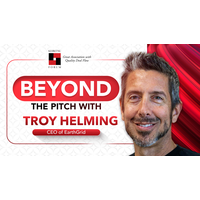
For Troy Helming, entrepreneurship is about solving problems big enough to matter, and hard enough that most people walk away.
Now on his eighth company, with four meaningful exits and one hard-earned failure behind him, Troy is building EarthGrid, a company that sounds like science fiction but addresses one of the most urgent challenges of our time: modernizing energy infrastructure so renewables can actually scale.
EarthGrid uses plasma-based excavation (technology Troy jokingly describes as “lightsabers”) to bore underground tunnels at unprecedented speed, enabling power lines to be buried, grids to become more resilient, and clean energy to move where it’s needed most.
In this Beyond The Pitch conversation, Troy shares the unconventional origin of EarthGrid, the patterns most founders miss, and why purpose, not capital, is what keeps him going when things get hard.
Troy, what inspired you to start EarthGrid? Why did this company need to exist?
I’ve spent most of my career in clean energy infrastructure. I started a wind farm development company in the late ’90s, Tradewind Energy, which eventually became the largest wind developer in North America and is now part of Enel Green Power.
Over the years, it became apparent that the biggest bottleneck for renewables wasn’t generation, it was transmission. We simply don’t have enough transmission lines to move clean energy from where it’s produced to where it’s needed.
In 2016, one of my solar projects was downsized by 75% after waiting over a year for grid studies. That was a massive loss. Later that night, while decompressing over drinks, one of my engineers, who happened to be a former Navy SEAL, mentioned using plasma torches to cut through ships underwater.
I couldn’t stop thinking about it. Plasma burns at tens of thousands of degrees. Could it cut through rock?
We ran a feasibility study. It worked. It was fast up to a kilometer a day. No one else was doing it. And the economics made sense. That’s when EarthGrid was born.
After multiple exits, what patterns do you spot that early-stage founders usually miss?
Focus.
There’s a saying I love: the wolf that chases two rabbits goes hungry.
Early-stage founders often listen to every investor, every customer, every piece of feedback, and end up trying to do too much. You have to know what the core customer needs, focus on that one thing, and execute it exceptionally well.
Once you’ve nailed these fundamentals, then you can expand. Until then, distraction is deadly.
You’ve spoken openly about having one failure. What did that teach you?
That failure came from trying to do too much, too early, with very thin margins.
The technology was ahead of its time. The economics didn’t work yet. The lesson was painful but straightforward: timing and margins matter. Even a good idea can fail if you don’t respect those realities.
Are there systems you put in place early to avoid chaos later?
Absolutely. I built my last three companies on rigorous project management systems. Whether you’re developing hardware, software, or delivering a service, you need a clear plan, clear milestones, and realistic forecasts.
That discipline isn’t limited to investors; it’s critical for customers as well. Credibility is built by doing what you say you’re going to do, when you say you’re going to do it.
When things get tough, what guiding belief do you come back to?
The power of purpose.
I grew up around clean energy. My father installed solar on our home decades ago. One of my chores as a kid was maintaining the system. I saw firsthand how clean energy could save money and reduce harm.
My mother also suffered severe health issues linked to pollution exposure. That left a deep impression on me.
When I get knocked down, and that happens often as an entrepreneur, it’s that purpose that gets me back up. I’m not just building companies. I’m trying to clean up our air, water, and food, and make energy cheaper in the process.
You’re also a competitive athlete. How does that shape you as a founder?
I always tell people to choose something that forces you to fail.
For me, it was obstacle course racing and competing on American Ninja Warrior. You fall. A lot. In front of people. And you have to get over your ego, shake it off, and try again.
That builds resilience. It teaches you not to fear failure or rejection. And that mindset shows up everywhere: fundraising, sales, hiring. Almost everyone says no at first. You just keep going.
What traits do you look for when building your team?
Three things: hungry, humble, and intelligent.
We’re doing something no one has done before. Our machines use plasma at extreme temperatures to turn rock into dust. It’s hard. People need to be willing to fail fast, learn, and take feedback.
Arrogance kills innovation. Hunger and humility move it forward.
You’ve raised from angels, family offices, and now institutions. How do you protect vision as the cap table grows?
By finding the right partners for the business.
I had a very difficult experience with a VC earlier in my career. It taught me the value of long-term alignment. At EarthGrid, we intentionally built a cap table dominated by angels and family offices who think long-term.
We now have hundreds of angels, cheerleaders across geographies who help with referrals, partnerships, and customers. That network is incredibly powerful.
You’ve raised capital from VCs, and you’re now raising from angels and family offices. What’s the difference—and why do you prefer angels?
The biggest differences are the time horizon and alignment.
Most venture capital funds operate on a fixed timeline. They need liquidity within five to seven years, which can create pressure to optimize for short-term outcomes, even at the expense of long-term value. Infrastructure and deep technology don’t always fit neatly into that window.
Angels and family offices tend to think differently. They’re often investing personal or generational capital, which gives them the patience to support long development cycles and the flexibility to let the company mature properly. That alignment matters a lot when you’re building something fundamentally new.
Another major difference is engagement. With angels, you’re building an ecosystem of capital and connections. At EarthGrid, we have hundreds of angels across different geographies, and many of them actively help with introductions, partnerships, and early customers. They become advocates, not just shareholders.
That doesn’t mean VCs don’t have a role. As companies scale, institutional capital can be incredibly valuable. But in the early stages, especially for capital-intensive, long-horizon businesses, I’ve found angels and family offices offer the right balance of patience, support, and strategic alignment.
What should founders have ready before they start fundraising?
Two things.
First, personal runway. Fundraising always takes longer than you think. Have at least 12 months of savings, so you’re not negotiating from a place of desperation.
Second, traction. It doesn’t have to be revenue, but it has to be something tangible: an MVP, LOIs, or pilot customers. Traction changes the entire conversation with investors.
If founders studied your career, what three lessons would you want them to take away?
One: lead with purpose.
Two: practice transparency with investors, employees, and customers.
Three: stay humble and scrappy. Hope for the best, but plan for the worst.