
If you’ve been writing checks in the private markets long enough, you know one universal truth: Time is just as big an enemy as risk and competition.
Angel investing has always required patience, waiting five, seven, sometimes ten years to see a meaningful exit. And even when the exit finally lands, the tax tail often eats away a chunk of the upside. But 2025 brought a quiet shift.
The revised Qualified Small Business Stock (QSBS) rules, effective July 4, 2025, introduce a tiered capital gains exclusion: 50% after three years, 75% after four years, and 100% after five years, alongside expanded eligibility thresholds. This change shortens the path to partial tax-free gains for new investments. We were happy to host Pat Gouhin from the ACA to share his thoughts on Investment Policy Tailwinds from Washington DC at the Investor Capital Expo in August 2025.
If you’re an angel investor looking at portfolio construction, follow-on pacing, and exit optionality, these changes have reshaped your entire return strategy.
Let’s break down what’s changed and how you can take advantage of it.
The Holding Period Introduces Graduated Exclusions Starting at Three Years
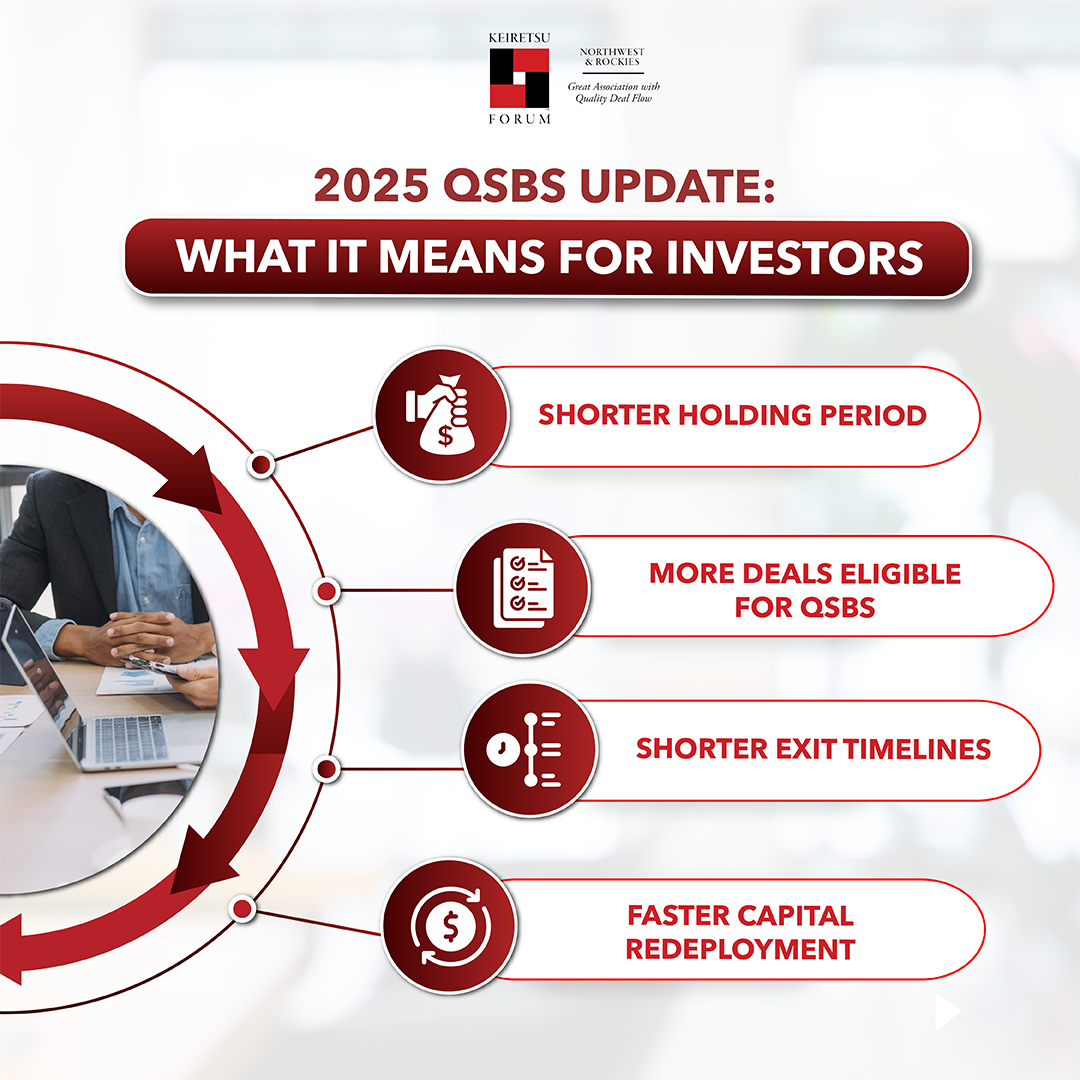
For years, QSBS’s five-year holding requirement acted like a tax incentive wrapped in handcuffs. Sure, the promise of tax-free upside was great, but waiting half a decade to qualify limited your ability to recycle capital and blunted the impact of early wins. The new three-year requirement changes the math dramatically.
A three-year horizon aligns much more naturally with how modern companies evolve, considering secondary activity, early strategic acquisitions, and even early revenue-based buybacks. What used to feel like “too early to sell” is now closer to “we’re already eligible.”
This shift also opens up far more flexibility in M&A conversations. When a company gets acquired in Year 3, angels may qualify for a 50% exclusion on gains if the stock was acquired after July 4, 2025, making earlier exits more attractive but only partially tax-exempt. Previously, you had to choose between selling early and paying taxes, or holding on longer and risking the deal altogether. With the updated rules, you can participate in earlier exit discussions without giving up QSBS benefits. And with a shorter clock, you also free up capital earlier, allowing for faster redeployment into new deals, more dynamic portfolio rotation, and a more substantial compounding effect across multiple QSBS-eligible investments over a decade.
Expanded Eligibility: Why More Deals Now Qualify
QSBS now allows qualifying issuers to have up to $75 million in gross assets (up from $50 million) for stock issued after July 4, 2025. This expansion particularly benefits growth-stage companies in sectors like manufacturing, robotics, deep tech, and AI infrastructure, enabling more deals to qualify. That means more of the companies you invest in will be eligible at check-writing time, fewer will “age out” as they scale, and you won’t lose QSBS protection simply because a business catches traction earlier than expected.
The sector restrictions have also softened. As industries like climate tech, industrial automation, defense tech, and scientific tooling evolve, many now fit better within QSBS’s definition of a qualified business. This permits angels to back technically intense companies without worrying that a narrow interpretation will disqualify the investment. In short, more of the companies that actually matter in the 2025 innovation landscape now fall under QSBS, making the incentive more relevant.
Exit Timelines Are Quietly Compressing
The new rule changes are already reshaping liquidity patterns. Employee and early-investor secondaries, once expected around Year 5, are now appearing in Years 2–3 for fast-moving businesses. Under the new QSBS rules, exits as early as Year 3 may qualify for a 50% exclusion on capital gains for new stock, providing partial tax benefits while encouraging earlier liquidity.
Acquirers, too, are moving faster. Strategic buyers love scooping up companies before valuations explode, and the three-year QSBS window lines up perfectly with the point at which many businesses reach early product-market fit, build a scalable go-to-market motion, and develop predictable revenue. This places the Year-3 to Year-4 range right in the sweet spot for midsized acquisitions, exactly when QSBS eligibility kicks in.
As a result, angels gain real bargaining power during negotiations. You no longer have to delay a good exit, worry about tax leakage, or hold out for a later round to maximize after-tax returns. You can optimize for cleaner, earlier outcomes while still retaining the full QSBS advantage.
A Faster, More Fluid Angel Ecosystem
QSBS was always meant to reward early risk-takers. The updated rules finally align with how modern innovation cycles actually work: faster, more capital-efficient, and increasingly acquisition-driven.
Shorter holding periods make angel investing more dynamic. Expanded eligibility makes more deals worth your attention. And faster tax-free liquidity means your capital can work harder, sooner.
For investors who know how to navigate these changes, this is the most significant boost to angel ROI in years.